
Why the four labour codes matter, and what they could change in how Indians get, change, and keep jobs!
In most policy debates, India’s labour codes are described simply: 29 laws consolidated into four codes to improve ease of doing business and simplify compliance. That is true. But it is not the story.
Because the real question is not legal. It is economic: How does an economy convert millions of informal jobs into formal, productive, credit-linked employment?
Once framed this way, the labour codes stop looking like regulation. They look like an attempt to build infrastructure for visibility.
A labour market that exists, but is not fully ‘seen’
India does not lack work. It lacks a consistent way of seeing work.
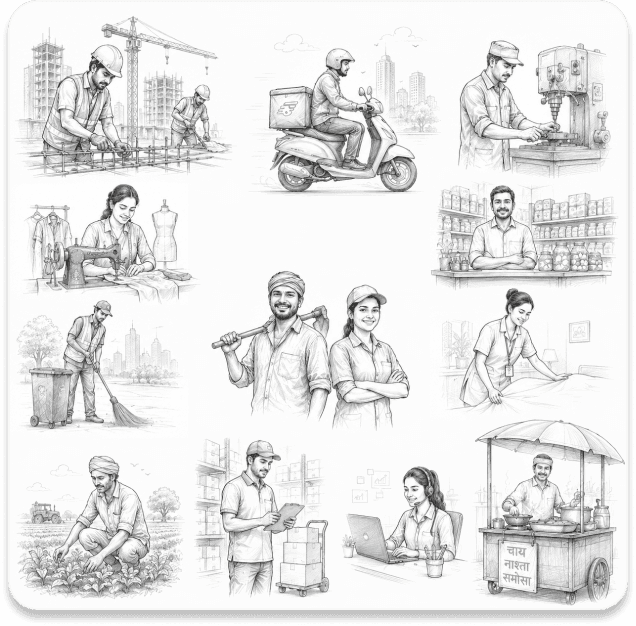
Imagine a humid morning in a small industrial cluster outside a tier-2 city. A contractor hires 12 workers for loading work. No contracts are signed. No system is updated. No formal record exists.
By evening, wages are paid in cash. If you asked the system what happened today, the answer would be simple: Nothing.
But this is not an exception. It is the default structure across millions of transactions every day. And because definitions vary across states and laws, even ‘employment’ is not a stable category.
Modern economies don’t scale on activity.
They scale on legibility. On whether work can be seen clearly enough to be taxed, financed, insured, and improved. India is still building that layer.
What the labour codes actually change?
At their core, the four codes - wages, industrial relations, social security, and occupational safety, do one basic thing:
They standardise the language of work. What counts as wages. Who is a worker. How employment is defined. What baseline protections apply. This is not cosmetic. Because in fragmented systems, definitions drive behaviour.
The labour codes are an attempt to reduce that ambiguity. Not by forcing behaviour. But by reducing interpretive cost.
The real mechanism is not policy. It is compounding.
This is the part most people miss. The effect is not linear. It is a chain reaction that only shows up after repetition.
Standardisation reduces ambiguity - Lower ambiguity reduces compliance friction - Lower friction reduces the cost of formal hiring - Lower cost increases formal adoption - Formal adoption increases visibility of wages and jobs - Visibility improves credit allocation and welfare targeting
What looks like legal simplification begins to behave like an economic feedback system.
A simple way to see the transition is this:
Informal hiring - fragmented documentation - weak credit linkage - low scalability
to:
Standardised contracts - formal payroll systems - data visibility - stronger credit and welfare linkage - scalable firms
The difference is not just compliance. It is whether labour becomes economically legible.
So the labour codes do not replace the system. They attempt to align it. And alignment is harder than replacement, because it depends not only on law, but on the infrastructure between law and work.
The maths of wages: where small changes become macro forces
{/* CHANGE: Updated text to blue-collar and grey-collar */}The most intuitive way to understand this shift is through wages.
Take a simple change: a blue-collar or grey-collar worker earning ₹12,00,000 per month moves to ₹14,000 per month. The difference is ₹2,000 monthly, or ₹24,000 annually.
Individually, this is modest.
But labour markets are not individual systems. They are aggregate systems.
Even if this shift applies to 20 million workers - a fraction of India’s blue-collar and grey-collar base, the additional income entering households becomes:
₹24,000 × 20,000,000 = ₹48,000 crore annually.
This is not just income redistribution. It is liquidity entering the consumption base of the economy.
And unlike higher-income households, this income does not sit idle. It moves quickly, into food, transport, rent, local retail, and services. So the effect is not just higher wages. It is higher velocity of demand in the most consumption-sensitive parts of the economy.
Once this money enters circulation, it does not remain linear. Local businesses respond first. Small retailers see higher turnover. Transport demand rises. Informal services expand hiring.
Once this income enters circulation, Part of the wage increase cycles back into employment itself. So the system stops behaving like a straight line and starts behaving like a loop:
income rises → consumption strengthens → local activity increases → hiring improves → wage pressure stabilises at a higher base
This is why wage shifts in a large informal economy are not linear events. They are recursive adjustments.
The execution gap: where the system actually changes
This is where most reforms succeed on paper but struggle in practice. For real-world examples of how wage benchmark disparities affect regional manufacturing hubs, see our analysis on what the Noida labor protest tells us about jobs in India.
Between job creation and formal employment lies a gap: jobs are created, but not recorded; workers are hired, but not consistently onboarded; wages are paid, but not fully visible in structured systems.
This is the execution layer. And this is where JobsUPI sits, not as policy substitutes, but as infrastructure connecting workers to verified jobs and helping employers search verified candidate profiles.
Their function is not to redefine labour, but to reduce friction in converting informal work into formal systems through structured hiring, onboarding, and employer compliance tools.
If labour codes define the rules of work, this layer determines whether those rules are actually usable. That is when labour stops being just employment. It becomes infrastructure for growth.